A whole-profile cognitive assessment
for gifted and 2e learners.
Eight cognitive domains, measured and reported independently. No composite score. No averaging that masks the asynchronous development defining your child's experience.
Evidence you can take to school, to a psychologist, to anyone who needs to see the full picture.
Recognition
The results say one thing.
Your experience says another.
Strong scores in some areas, real struggles in others, and an overall picture that doesn't quite capture either. That's not a contradiction. It's an uneven cognitive profile, and most assessments weren't built to show it.
When assessment tools can't capture uneven cognitive profiles, families and educators both struggle with incomplete information. Wadmore gives everyone the whole profile.
The Difference
Traditional assessments hide the pattern
Wadmore maps the complete cognitive profile
The Problem
Traditional assessments weren't built for profiles like your child's
They weren't designed for uneven profiles. They were designed assuming even capability.
The Solution
How Wadmore helps gifted and 2e learners
Assessment architecture designed for uneven cognitive profiles.
No more averaging
Eight separate domains mean uneven profiles stay clear. Band 9 Abstract Reasoning and Band 4 Executive Functioning both get reported. No composite hiding the pattern.
Uneven profiles expected
Our 12-band developmental framework expects asynchronous development. Wide variation between domains is documented, not averaged. It's how capable learners often perform.
Growth pathways for advanced learners
The scale runs to professional-level bands, so advanced learners show where their next step sits instead of hitting the top.
Strength-based support planning
Lead with strengths, identify growth areas, provide evidence for accommodations - without questioning capability. Gifted AND needs support.
Evidence for school advocacy
Construct-level evidence of both exceptional capability and specific support needs. Evidence that can contribute to school adjustment planning and NCCD records.
From confusion to clarity
Understand the pattern behind inconsistent performance. Why brilliant one moment, struggling the next. The cognitive profile shows the pattern.
An Uneven Profile
What this looks like in Wadmore.
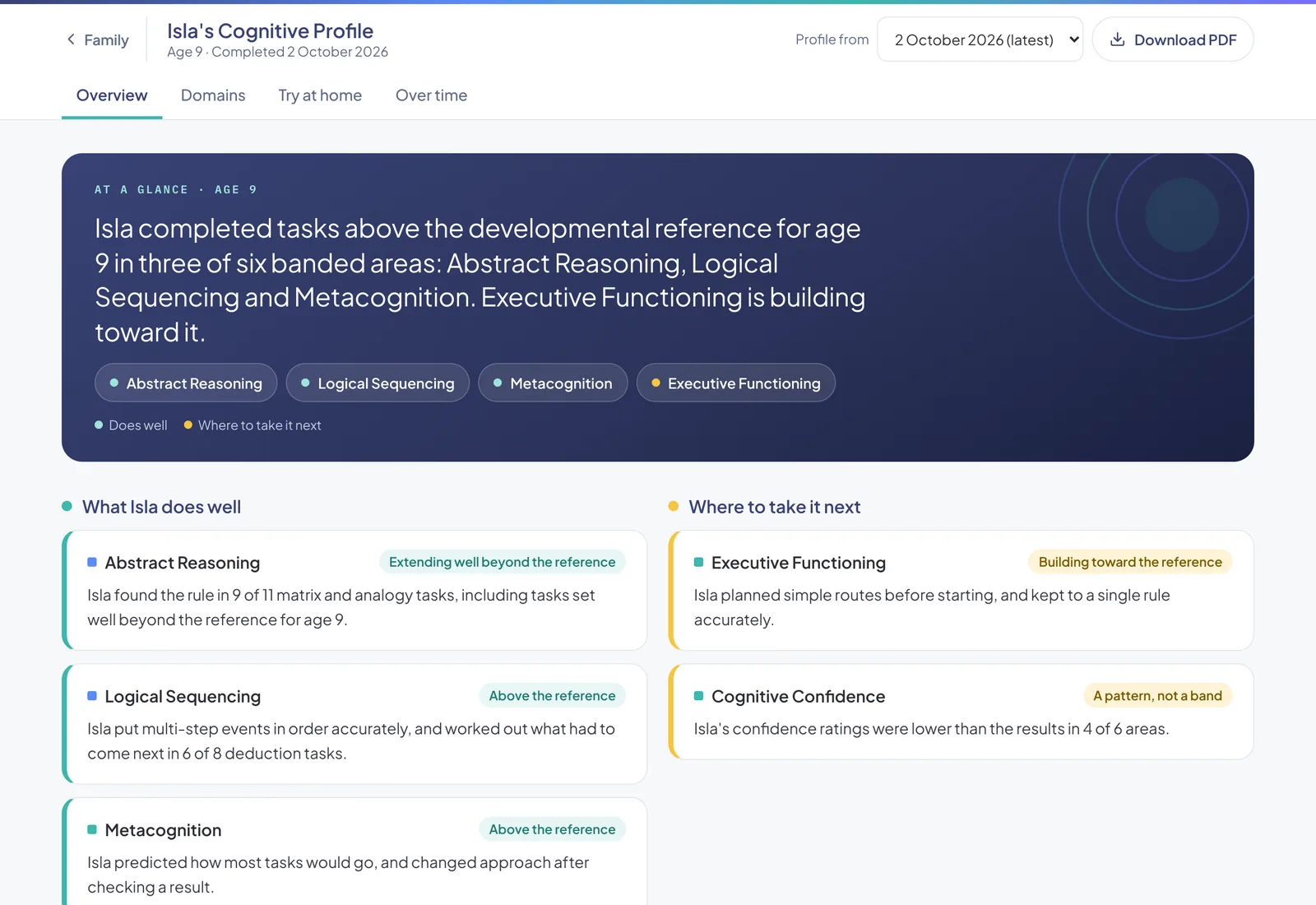
Abstract Reasoning extending well beyond the reference for age 9, and Executive Functioning building toward it: a strength and a support need, visible in one profile because nothing is averaged.
Profile Examples
Uneven profiles are common
Uneven profiles are common among capable learners and among learners with diagnosed conditions. Wadmore reports each domain separately so the unevenness is visible rather than averaged away. It does not diagnose, and it does not tell you what a pattern means for a particular child. That is a conversation for your school and, where needed, a registered psychologist, and the profile is built to be brought into it.
Research Foundation
Grounded in science, not trends
Two kinds of evidence
Every school holds two kinds of
evidence about a student.
One records what they've produced. The other shows the cognitive capability they're developing.
Artefact evidence
What the student produces. Valuable, rich, and now of unknowable provenance.
Capability evidence
Observable cognitive performance under known conditions. Observed as it happens, not handed in afterwards.
Generative AI corrupted the first kind. It left the second untouched.
Artefact evidence remains valuable. It is no longer sufficient on its own.
Artefact-independent measurement
AI can produce the output.
It cannot produce the student's capability.
Drag the handle. The work is on the surface. The cognitive capability is underneath.
Uneven, individual, and measured one timed response at a time.
The water cycle describes the continuous movement of water through Earth's atmosphere, surface, and underground systems.
Evaporation occurs when solar radiation transforms surface water into vapour, which rises and cools into condensation.
Precipitation then returns water to the surface, where it collects, infiltrates, and ultimately flows back toward the oceans.
Together these processes form a closed system that has sustained life on Earth for billions of years.
Produced in seconds. By anyone, or anything.
AI makes capability harder to see. Wadmore makes it visible.
Ready to see the full picture?
Eight domains, profiled separately. Evidence for advocacy, support planning, and extension.
Questions? Email us at hello@wadmore.com.au